 The Humane Society of the US takes a lot of heat from critics about how it manages its money. But do those complaints have any validity?
Let’s examine some of the claims.
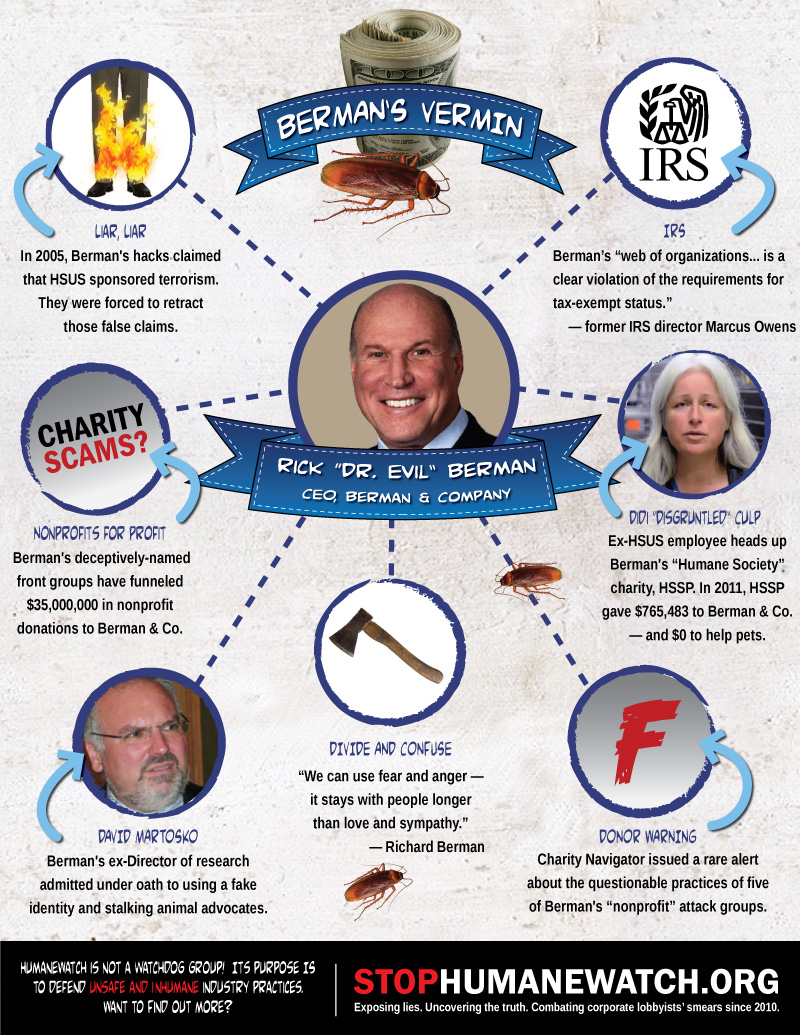
On April Fools’ Day, 2010, David Martosko of HumaneWatch published a blog post critical of HSUS pensions, claiming it’s a “scandal lurking beneath the surface”. (Martosko carefully weeds out comments critical of HumaneWatch on the grounds that they are “being rude”; apparently, this rule doesn’t apply to HumaneWatch supporters who insinuate that female directors of HSUS are prostitutes. But that’s a topic for another day.)
HumaneWatch is correct that in 2008, HSUS contributed over $2-million to its employees’ retirement accounts. HSUS had 555 paid employees in 2008. If we divide $2,532,167.00 by 555, we get an average pension contribution of $4,562.46 that year.
We compared six other non-profit organizations to see if HSUS contributions are excessive.
Two of the organizations are prominent, nationwide, animal-related charities: the ASPCA, and the American Kennel Club. Three are prominent, nationwide, agricultural advocates: the American Meat Institute, the American Farm Bureau Federation, and the National Milk Producers Federation. And we rounded out the collection with the American Red Cross.
Here are the results.
| Employees | Total Pension | Average | |
| American Kennel Club | 532 | $522,077.00 | $981.35 |
| American Red Cross | 36,287 | $71,732,611.00 | $1,976.81 |
| ASPCA | 596 | $1,854,331.00 | $3,111.29 |
| American Farm Bureau Federation | 90 | $282,420.00 | $3,138.00 |
| HSUS | 555 | $2,532,167.00 | $4,562.46 |
| American Meat Institute | 41 | $260,071.00 | $6,343.20 |
| National Milk Producers Federation | 17 | $512,990.00 | $30,175.88 |
As you can see, HSUS ranked slightly above the middle. The lowest was the American Kennel Club with a paltry $981, and the worst was the National Milk Producers Federation at a staggering $30,175.88 per employee.
However, this isn’t a precise measure. For example, the American Farm Bureau ranked better than HSUS, but on closer inspection we found that over $96,000 of their total pension contributions went into the accounts of their CEO. Because charities and for-profit corporations are reluctant to reveal the intimate details of their retirement benefits, we can’t know for certain how many employees actually receive those benefits, so this is a rough guideline only.
Let’s look at another claim. On May 14, 2009, WSB-TV aired a badly flawed investigation into HSUS finances, a report which relied heavily on misinformation provided by David Martosko and CCF. (We covered that deception, and WSB-TV’s retraction of the story in a previous article on HWI, if you’re interested in how HumaneWatch takes advantage of those who don’t double-check their sources.) The broadcast contained typical misstatements by David Martosko, such as the claim that HSUS funds “go to pay huge staff salaries and benefits”.
So, let’s look at salaries.
| Average Salary | |
| American Red Cross | $47,856.33 |
| ASPCA | $58,235.77 |
| American Kennel Club | $60,762.89 |
| HSUS | $68,095.11 |
| American Meat Institute | $108,988.37 |
| American Farm Bureau Federation | $131,277.91 |
| National Milk Producers Federation | $183,627.35 |
With an average employee compensation of $68k, HSUS falls in the middle of the scale. It weighs in slightly higher than the American Kennel Club, and far below the exceptionally generous dairy farmer’s lobbyist group. Despite the high number of veterinary, legal, and other professionals HSUS employs, its average pay is less than all three agricultural advocates on the list.
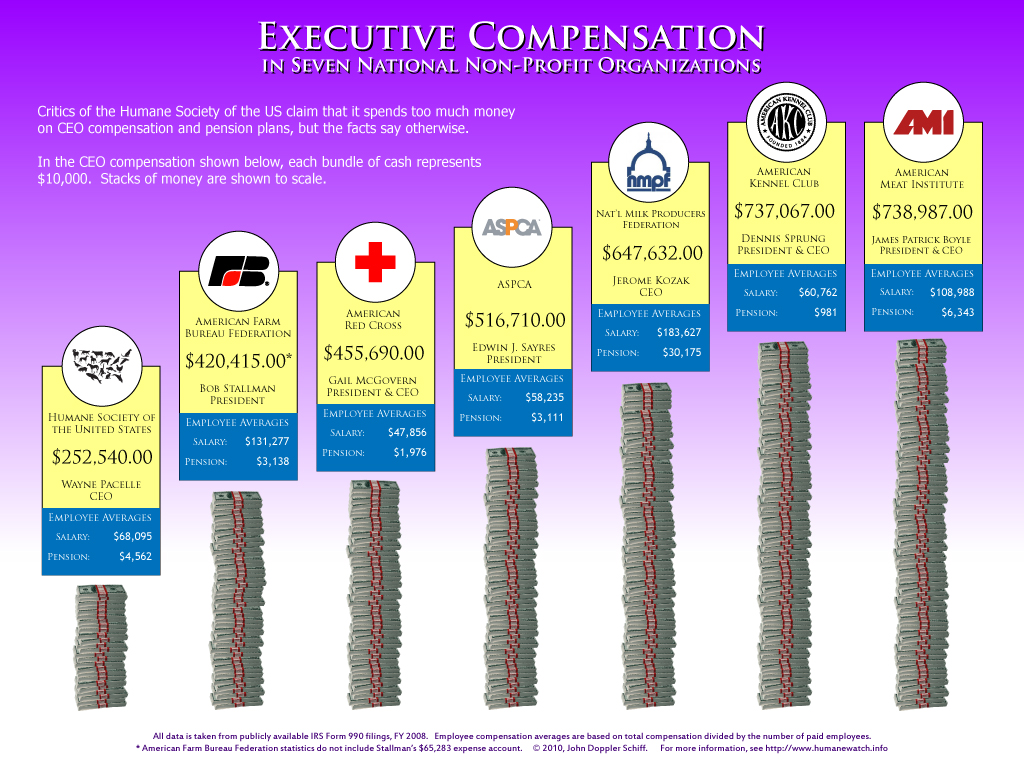
But what about Wayne Pacelle, the CEO of HSUS whose salary has been described as “lavish”, “excessive”, and “egregious”?
| CEO Compensation | |
| HSUS | $252,540.00 |
| American Farm Bureau Federation | $420,415.00 |
| American Red Cross | $455,690.00 |
| ASPCA | $516,710.00 |
| National Milk Producers Federation | $647,632.00 |
| American Kennel Club | $737,067.00 |
| American Meat Institute | $738,987.00 |
That’s right, critics: Wayne Pacelle’s “egregious”, “lavish”, “excessive” compensation is the lowest of any of the non-profits in the list, and less than 35% of the bloated salaries of the American Kennel Club and American Meat Institute CEOs.
What constitutes excessive compensation for a non-profit? That’s a matter of opinion. However, it’s clear from these comparisons that if HSUS compensation is too high, it’s a problem shared by many national charities, and to a far greater degree than the Humane Society of the US.
We close this article with some thoughts from the outstanding CEO Compensation Study at CharityNavigator, and an illustration from our webmaster, John Doppler Schiff:
…[A]s the size, and thus the complexities of running a nonprofit increase, so does the salary of the institution’s top executive so much so that if we probe deeper into the top tier of charities (by size), we see even larger salaries. A look at organizations with total expenses between $50 and $100 million pay their CEOs on average $378,026 and organizations with total expenses of $100 million or more pay their CEOs on average $462,037. In illuminating this information, it is not our intention to give donors, who often bemoan this level of pay, an excuse to not support a great charity.Rather, we want donors to understand and appreciate that the top nonprofit leaders, those who are sought after for their ability to manage multi-million dollar institutions and who are tasked with the mammoth goal of making the world a better place, command significant salaries.
…[W]e recognize that many donors will be hesitant to agree that the CEO of their favorite charity deserves a six figure salary. To the skeptics, we ask that you keep in mind that the charities included in this study are multi-million dollar operations. Leading one of them requires an individual that possesses both an understanding of the issues that are unique to the charity’s mission as well as business and management expertise similar to that required of for-profit CEOs… For comparative purposes, the average salary of CEOs at S&P 250 companies is $1 million, excluding bonus packages and stock options that drive the average compensation up to $7.6 million.
Update: August 6th, 2010
The term “charity” was replaced with “non-profit organization”: the two terms are not always interchangeable. Thanks to reader Tracy H. for catching the error!
Update: January 15th, 2011
An updated look at compensation among national nonprofits and for-profits is available here.